

Cocoa farming presents one of the best
business opportunity in Agribusiness. The
demand for cocoa seeds worldwide is
extremely high and the price in international
market is quite encouraging to farmers. You
already know what cocoa is used for. There
will be no chocolate on the shelf without the
cocoa seeds. Confectionery and Beverage
making companies will go out of business if
cocoa farmers stops farming.
You plant cocoa trees once and harvest it
throughout your lifetime and still pass it to the
generation next! Cocoa beans is one of the
hottest agricultural product in the market
anywhere in the world. If you have ever been
to cocoa farm, you would realize how
beautiful cocoa farm can be, probably one of
the best place to get closer to nature.
Setting Up Cocoa Farm
Locate a large expanse of forest land with the
appropriate climate and suitable rainfalls.
Cocoa seedling is very sensitive and can die
off quickly if not handled properly. Under the
forest canopy is the ideal place to plant
cocoa. The land you intend to use for your
cocoa farming must be covered by rain forest
canopy. The trees need even temperatures
between 21-23 degrees Celsius, with a fairly
constant rainfall of 1000-2500mm per year.
Get good and improved cocoa variety from
reliable source. International Institute for
Tropical Agriculture will be a good place to get
the cocoa variety with some advice. Or if you
want to take the gamble, you just get the
cocoa seeds directly from cocoa farm from an
experienced cocoa farmers.
Clear the forest and plant the cocoa seeds at
the beginning of raining season. Best period
for planting cocoa is around April May when
the raining reason is just picking up.
Climate Condition For Cocoa
Farming
Cocoa is produced in countries in a belt
between 10ºN and 10ºS of the Equator, where
the climate is appropriate for growing cocoa
trees. The largest producing countries are
Ivory Coast, Ghana and Indonesia.
The natural habitat of the cocoa tree is in the
lower storey of the evergreen rainforest, and
climatic factors, particularly temperature and
rainfall, are important in encouraging optimum
growth.
Cocoa plants respond well to relatively high
temperatures, with a maximum annual average
of 30 – 32ºC and a minimum average of 18 –
21ºC.
Variations in the yield of cocoa trees from
year to year are affected more by rainfall than
by any other climatic factor. Trees are very
sensitive to a soil water deficiency. Rainfall
should be plentiful and well distributed
throughout the year. An annual rainfall level of
between 1,500mm and 2,000mm is generally
preferred. Dry spells, where rainfall is less
than 100mm per month, should not exceed
three months.
A hot and humid atmosphere is essential for
the optimum development of cocoa trees. In
cocoa producing countries, relative humidity is
generally high: often as much as 100% during
the day, falling to 70-80% during the night.
The cocoa tree will make optimum use of any
light available and traditionally has been grown
under shade. Its natural environment is the
Amazonian forest which provides natural
shade trees. Shading is indispensable in a
cocoa tree’s early years.
Soil Condition And Property
Cocoa needs a soil containing coarse particles
and with a reasonable quantity of nutrients, to
a depth of 1.5m to allow the development of a
good root system. Below that level it is
desirable not to have impermeable material,
so that excess water can drain away. Cocoa
will
withstand waterlogging for short periods, but
excess water should not linger. The cocoa
tree is sensitive to a lack of water, so the soil
must have both water retention properties and
good drainage.
The chemical properties of the topsoil are
most important, as the plant has a large
number of roots for absorbing nutrients. Cocoa
can
grow in soils with a pH in the range of 5.0-7.5.
It can therefore cope with both acid and
alkaline soil, but excessive acidity (pH 4.0 and
below) or alkalinity (pH 8.0 and above) must
be avoided.
Cocoa is tolerant of acid soils, provided the
nutrient content is high enough. The soil
should also have a high content of organic
matter: 3.5% in the top 15 centimetres of soil.
Soils for cocoa must have certain anionic and
cationic balances. Exchangeable bases in the
soil should amount to at least 35% of the total
cation exchange capacity (CEC), otherwise
nutritional problems are likely. The optimum
total nitrogen / total phosphorus ratio should
be around 1.5.
Suitable Cocoa Varieties
Criollos – This variety dominated the market
until the middle of the eighteenth century, but
today only a few, if any, pure Criollo trees
remain.
Criollo is considered the finest of the luxury
cocoas. Only mildly acidic and hardly bitter at
all, it possesses a mild cocoa taste with
distinctive secondary aromas and hints of
nuts, caramel, forest fruits and tobacco.
Because the Criollo plant is more susceptible
to fungal disease and other pests, it produces
smaller yields and its fruits are therefore more
expensive.
Forastero – This cocoa is considered the
forefather of all cocoa varieties and delivers
very good harvests thanks to its robustness. It
accounts for some 80% of global cocoa
cultivation. Typical characteristics of
Forastero are its powerful, less aromatic
cocoa flavour that can in some cases be bitter
or acidic. The back looks hard and rough and
can be found easily in Nigeria, Ghana, and
Ivory Coast.
The Trinitario – This populations are
considered to belong to the Forasteros,
although they are descended from a cross
between Criollo and Forastero. Trinitario
planting started in Trinidad, spread to
Venezuela and then to Ecuador, Cameroon,
Samoa, Sri Lanka, Java and Papua New
Guinea.
Trinitario combines the hardiness of consumer
cocoa with the pleasant flavours of luxury
cocoa. Trinitario cocoa has a powerful,
aromatic cocoa taste and is only slightly
acidic.
Cocoa Breeding Methods
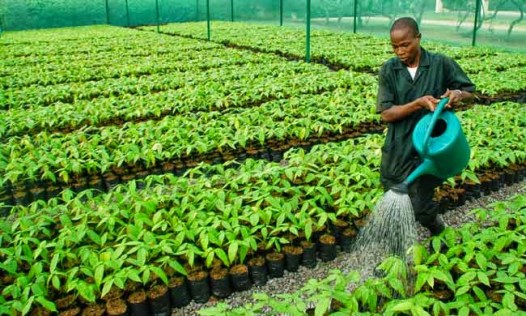
Cocoa is raised from seed. Seeds will
germinate and produce good plants when
taken from pods not more than 15 days
underripe.
Cutting – Tree cuttings are taken with
between two and five leaves and one or two
buds. The leaves are cut in half and the
cutting placed in a pot under polyethylene
until roots begin to grow.
Budding – A bud is cut from a tree and
placed under a flap of bark on another tree.
The budding patch is then bound with raffia
and waxed tape of clear plastic to prevent
moisture loss. When the bud is growing, the
old tree above it is cut off.
Marcotting – A strip of bark is removed from
a branch and the area covered in sawdust and
a polyethylene sheet. The area will produce
roots and the branch can then be chopped off
and planted.
 agrobuss.com