
Among the most enduring and damaging impacts of Nigeria’s oil and gas resource curse has been the long, steady decline of the country’s agricultural sector. Once the primary source of government revenue and foreign exchange earnings, agriculture in Nigeria has suffered from decades of under-investment, corruption, policy neglect, and lost opportunity. Today, despite its vast agricultural potential, the country is a net food importer of food, with the vast majority of people engaged in agriculture operating at subsistence level.
During its first decade of independence, Nigeria was one of the world’s most promising agricultural producers. Regionally focused policies based on the economic principle of commodity comparative advantage ensured that the agricultural sector served as the nation’s main source of food and livelihoods. Nigeria was not only agriculturally self-sufficient and food secure, but it thrived in global markets as the world’s largest producer of groundnuts and palm oil and as a significant producer of cotton and cocoa. Agriculture was the nation’s main source of employment and income. In 1965, the agricultural sector employed over 70 percent of the labor force. Export cash crops were responsible for 62.2 percent of the young nation’s foreign exchange and 66.4 percent of its GDP. Northern cities like Kano, with its towering groundnut pyramids, employed large swathes of the population and became regional economic hubs, emblematic of the nation’s agricultural wealth. These northern cities were linked to southern ports like Lagos through extensive and reliable rail networks that fostered economic interdependence and regional integration.

Food security has become an issue of global concern in the recent time. Nigeria, with her huge endowed natural and human resources is not spared. Nigerian food crisis is a product of colonial disorientation that has led to neglect of the peasant agriculture and food crops sub-sector as well as over reliance on cash crops production and the oil sector. Nigeria still has the potentials to be food-secure if the following strategies are adopted and implemented: rural development, provision of easy access to basic farm inputs, adequate budgetary allocations to agriculture particularly to the food crop sub-sector, enunciation of appropriate policies for food crop sub-sector, political stability, reduction in rural poverty, and peasant farmers‟ education.
A young person forms a sustainable connection to the world within or around themselves. From that understanding, it becomes obvious why youth are important to agriculture and the economy in general. They are important because they are consumers, innovators, workers, entrepreneurs, recyclers, producers and leaders right now – and in the future.

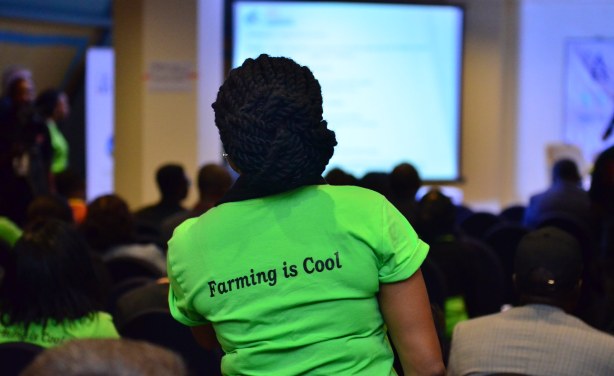
Rural youth are the future of food security. Yet around the world, few young people see a future for themselves in agriculture or rural areas. Rural youth face many hurdles in trying to earn a livelihood. Pressure on arable land is high in many parts of the world, making it difficult to start a farm. Youth often also lack access to credit, and many other productive resources necessary for agriculture. But even if such hurdles can be overcome, isn’t urban life much cooler? Perhaps, but not if you cannot make a living there. Particularly in developing countries, rural youth find themselves in such a bind. While most of the world’s food is produced by (ageing) smallholder farmers in developing countries, older farmers are less likely to adopt the new technologies needed to sustainably increase agricultural productivity, and ultimately feed the growing world population while protecting the environment. Hence, we need to re-engage youth in agriculture. Can this be done?
Food security is defined by the Food and Agriculture Organization (FAO(link is external)) as:
when all people, at all times, have physical, social and economic access to sufficient, safe and nutritious food that meets their dietary needs and food preferences for an active and healthy life.
Food security has four interrelated elements: availability, access, utilisation and stability.
- Availability is about food supply and trade, not just quantity but also the quality and diversity of food. Improving availability requires sustainable productive farming systems, well managed natural resources, and policies to enhance productivity.
- Access covers economic and physical access to food. Improving access requires better market access for smallholders allowing them to generate more income from cash crops, livestock products and other enterprises.
- Utilisation is about how the body uses the various nutrients in food. A person’s health, feeding practices, food preparation, diversity of their diet and intra-household distribution of food all affect a person’s nutrition status. Improving utilisation requires improving nutrition and food safety, increasing diversity in diets, reducing post-harvest loss and adding value to food.
- Stability is about being food secure at all times. Food insecurity can be transitory with short term shocks the result of a bad season, a change in employment status, conflict or a rise in food prices. When prices rise, it is the poor who are most at risk because they spend a much higher portion of their income on food. Poor people in Malawi spend nearly 78% of their income on food, while poor in the US, spend just 21% (CCAFS 2014(link is external)). Social nets can play an important role is supporting people through transitory food insecurity.
Nigeria has made some positive steps toward maximizing its agricultural potential. In terms of food self-sufficiency, for example, rice production has significantly increased (although Nigeria missed its target of becoming self-sufficient in rice by 2015), and deals have been struck with China to build on the progress by constructing 40 rice mills. Investors estimate that improved rice and production will shave $5 billion off the cost of food imports in the next five years. Deregulation in the fertilizer and seed sectors has reduced market inefficiencies, curbed corruption, and ensured that more farmers get their hands on the inputs they need. Some state governments have taken a strategic approach to agriculture and followed up commitments with resources. They include Cross Rivers State, already the largest producer of palm oil in Nigeria, which recently signed a deal with the ThaiAfrica Corporation to develop a town dedicated to rice production; and Jigawa State, where a concerted effort to attract private-sector investment in agriculture under Governor Baduru Abubakar has secured some big commitments. The current and previous federal administrations have succeeded in attracting more private-sector investment in agriculture, signing deals with the likes of Dangote Group to provide mechanized equipment for hire to farmers and Coscharis Group to start large-scale rice production in Anambra State.Yet despite pockets of good performance, Nigeria is not fully exploiting its rich natural and human resources. The country’s abundance of arable land is underutilized; many farmers lack access to modern inputs, credit, and markets; and research and technology are not being rigorously applied to agricultural problems. Overall, insufficient public funds are being put into agriculture. Those that are invested are often spent unwisely or inefficiently. In order to spur transformational growth in Nigeria’s agriculture sector, action is required in a number of strategic areas:
- Agricultural development needs consistent, high-level policy attention: President Buhari has spoken frequently about the importance of agriculture as an incubator of economic growth, jobs, and food security. But moving from words to actions is often a stumbling block in Nigeria. So too is the tendency for new administrations to throw out the policies of their predecessors. This would be a mistake in the area of agriculture, where important progress was made under Minister Adesina. The new minister of agriculture has pledged no “policy somersaults,” although his ability to withstand competing pressures has yet to be proven.11 Agricultural reform and transformation will require policy stability and continuity that builds and improves on the progress already made.
- More resources, spent wisely: Nigeria will need to boost the agriculture budget at all three levels of the government system, matching the rhetoric on the importance of agriculture with a financial commitment to support it. This is easier said than done during a period of economic turmoil, but the current oil price slump should focus minds on the importance of accelerating economic diversification, and the agriculture sector is the obvious place to start. Nigeria has not come close to meeting the African Union’s Comprehensive Africa Development Programme (CAADP) guideline for African countries to spend at least 10 percent of their budgets on agriculture, despite a commitment to do so. Agriculture spending averaged just 4.6 percent of overall federal spending between 2008 and 2014.12 Not surprisingly, the contribution of the agricultural sector to overall gross domestic product (GDP) has declined over the same period.
- All tiers of government should pull their weight: State and local government areas (LGAs) should be doing more to boost internally generated revenue and reduce their reliance on the federation account, which for most states has merely encouraged indebtedness.13 Even with increased funding, states and LGAs need to allocate budgets better and more efficiently and match expenditure to policy priorities. That means joint budget and project planning among the tiers of government, more transparent budgeting systems, and better public financial management. Efforts should be made to clarify the roles and responsibilities of the three tiers of government for agriculture policy and delivery. Currently, overlapping functions only serve to create confusion and undermine accountability. The ATA has identified this problem and is trying to address it, but little progress has been made.
- Place more emphasis on research and development: Nigeria is home to many agricultural colleges and research centers, including 15 national agricultural research institutes and the International Institute for Tropical Agriculture, part of the Consortium of International Agricultural Research Centers (CGIAR) network. Spending on agricultural research, however, amounted to only 0.3 percent of overall agricultural GDP in 2011.14 Furthermore, evidence suggests that investments in agricultural research are leading to poor outcomes.15 Better management systems would strengthen the research climate in Nigeria. Greater emphasis must be placed on developing research that provides practical solutions to the problems faced by farmers.
- Don’t forget the smallholder farmer: Nigeria understandably wishes to boost commercial farming, but more than 90 percent of Nigerian farmers tend plots of land less than two hectares in size.16 Though there have been significant efforts to improve the distribution of quality inputs to farmers, they fall far short of what is required. Similarly, the raft of policies under the ATA intended to address the poor state of extension services for smallholder farmers have not led to noticeable improvements on the ground. Agriculture officials working at the federal, state, and local levels must place more emphasis on policy delivery
- Nurture young farmers: Finally, more must be done to market agriculture as an attractive career option for young people and provide incentives for youth to take up farming. Grand ambitions have been unveiled, including a plan—supported by the UN Food and Agriculture Organization—to turn 740,000 graduates into “young agribusiness entrepreneurs” by providing training programs across all 36 states.17 A modest start has been made, with the launch of pilot projects in six areas. Sustained commitment will be required to scale up the program.
Conclusion.
Nigeria has embarked on the right track by framing an agricultural policy that sets clear priorities, recognizes the different needs of smallholder farmers and large-scale producers, and emphasizes the involvement of the private sector. But laying out a vision is only the first stage in the process. Plans must be executed, which will require greater political commitment at the federal, state, and local levels. Most of all, the Nigerian government must accompany its persuasive words on the importance of agriculture with a greater financial commitment toward the sector. This will be difficult at a time of fiscal hardship, but making smart investments now could bring long-term rewards by placing Nigeria’s economy on a firmer footing, providing a steady supply of jobs, and boosting food security in a country that should be more than capable of feeding itself and its neighbors.
 agrobuss.com